
Just a few hours from Bangkok, this infamous Thai bridge is home to one of the most brutal wartime projects ever carried out and cost 16,000 lives.
Stepping out of the entrance of my hostel just before 7 a.m., the immense, never-ending bustle of Bangkok wakes me more than any 7-Eleven iced coffee ever could. When I get into a Grab car (I haven’t yet mustered the courage to get on the back of a motorbike), I am driven through the backstreets and main roads, past the hundreds of motorbikes, produce markets and temples. Even four days into my stay, I am still awestruck at the scale and magnitude of Thailand’s capital city. My destination, though, is past the city lines: Kanchanaburi, a small town almost 80 miles west of the capital and immortalised through one of the most famous war films of all time, “The Bridge on the River Kwai” (1957).
As a confessed history buff, I am a little ashamed to admit that, although I had heard of the Bridge over the River Kwai and was acutely aware of the history surrounding its construction, I didn’t actually know where it was. So when, just a week before I arrived in Bangkok, I discovered that Kanchanaburi was only a two-and-a-half-hour train from Thailand’s capital, it was very quickly added to my itinerary. What follows is a memorable day, and though it is difficult to take in the horrors of what occurred there, it is necessary to fully understand and appreciate the true nature of the lives of prisoners of war in the Pacific Theater at the hands of the Imperial Japanese Forces.
The Bridge over the River Kwai was part of the infamous Thai-Burma Railway, often referred to as the Death Railway due to the vast numbers of casualties accumulated over its construction. Built by British, Australian and Dutch prisoners of war (POWs), as well as indentured Asian laborers shipped over to Thailand by Japanese forces, the network spanned from Ban Pong in central Thailand up to Thanbyuzayat, Myanmar, and was 218 miles long. It claimed the lives of over 100,000 people, including around 16,000 POWs and over 90,000 indentured laborers. Built between 1940 and 1943, the railway was envisioned to supply troops and weapons in the Burma campaign, part of Japan’s attempts to gain total control over Southeast Asia. The POWs were forced to live in brutal conditions, made to walk for hours each day while carrying heavy materials, with little to no food or sanitation, causing many to die from malnutrition, dehydration, cholera or malaria.
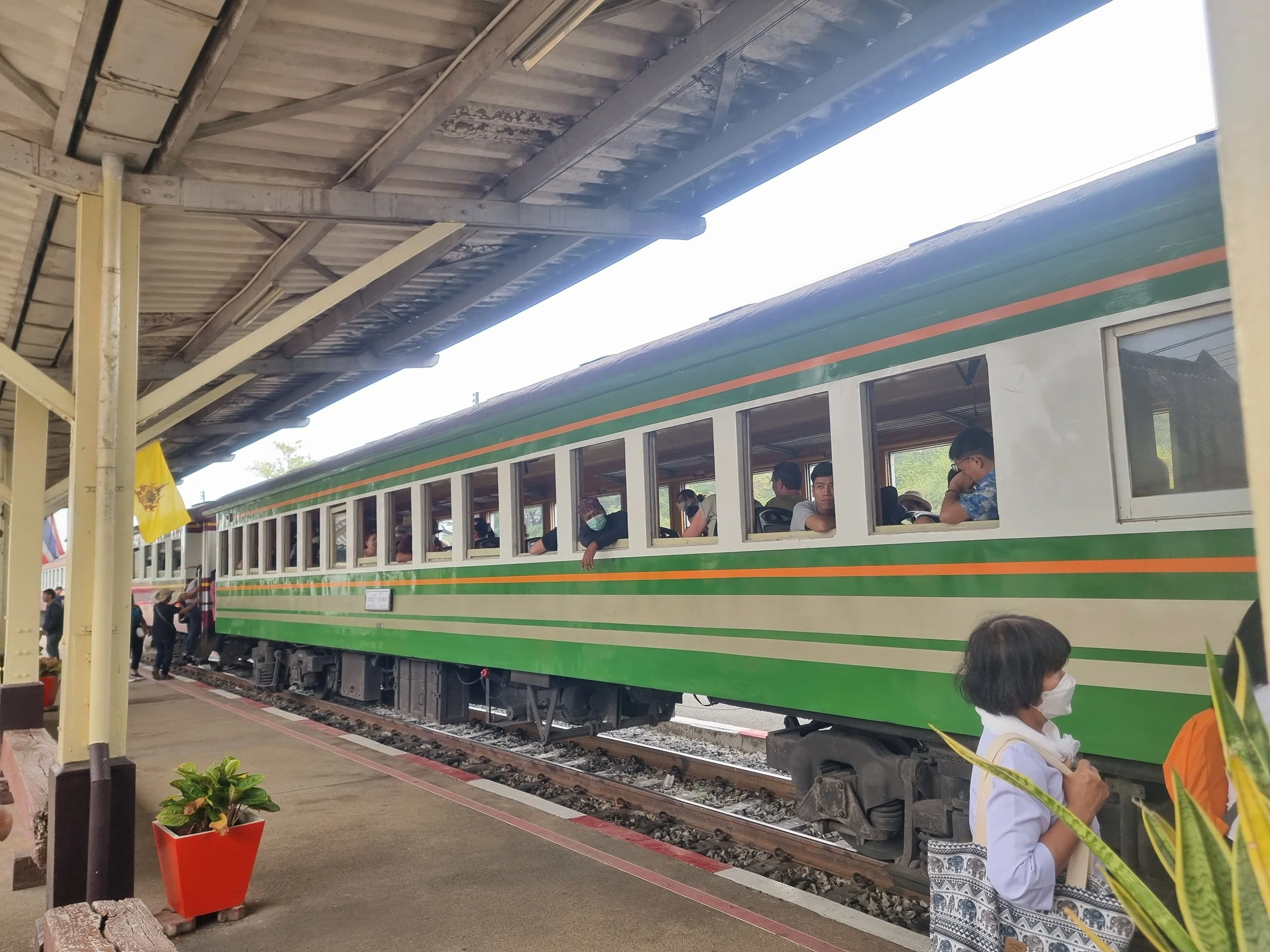
As I arrive at Thonburi station, I approach the ticket office and book the 257 train to Kanchanaburi. The ticket costs 100 baht (around 3 dollars) for foreign nationals and is free for Thai citizens. Boarding the old wooden train, you really are transported through time as you take your seat on a plastic bench, with no air conditioning to cool you down, just the breeze from the open windows and the small fans hanging in the corners of the carriages. Luckily for me, the early morning start means the temperature is not too intense. The journey takes approximately two and a half hours, traveling through rolling green hills, past rivers and small villages, a snapshot into life outside Thailand’s sprawling metropolis. You will be greeted by the sight of old women washing clothes in the streams and animals running on dirt roads, with the small pockets of ordinary life gradually giving way to the spectacular scenic views. It provides a great sense of calm and serenity, much needed before the emotional and sobering day ahead.
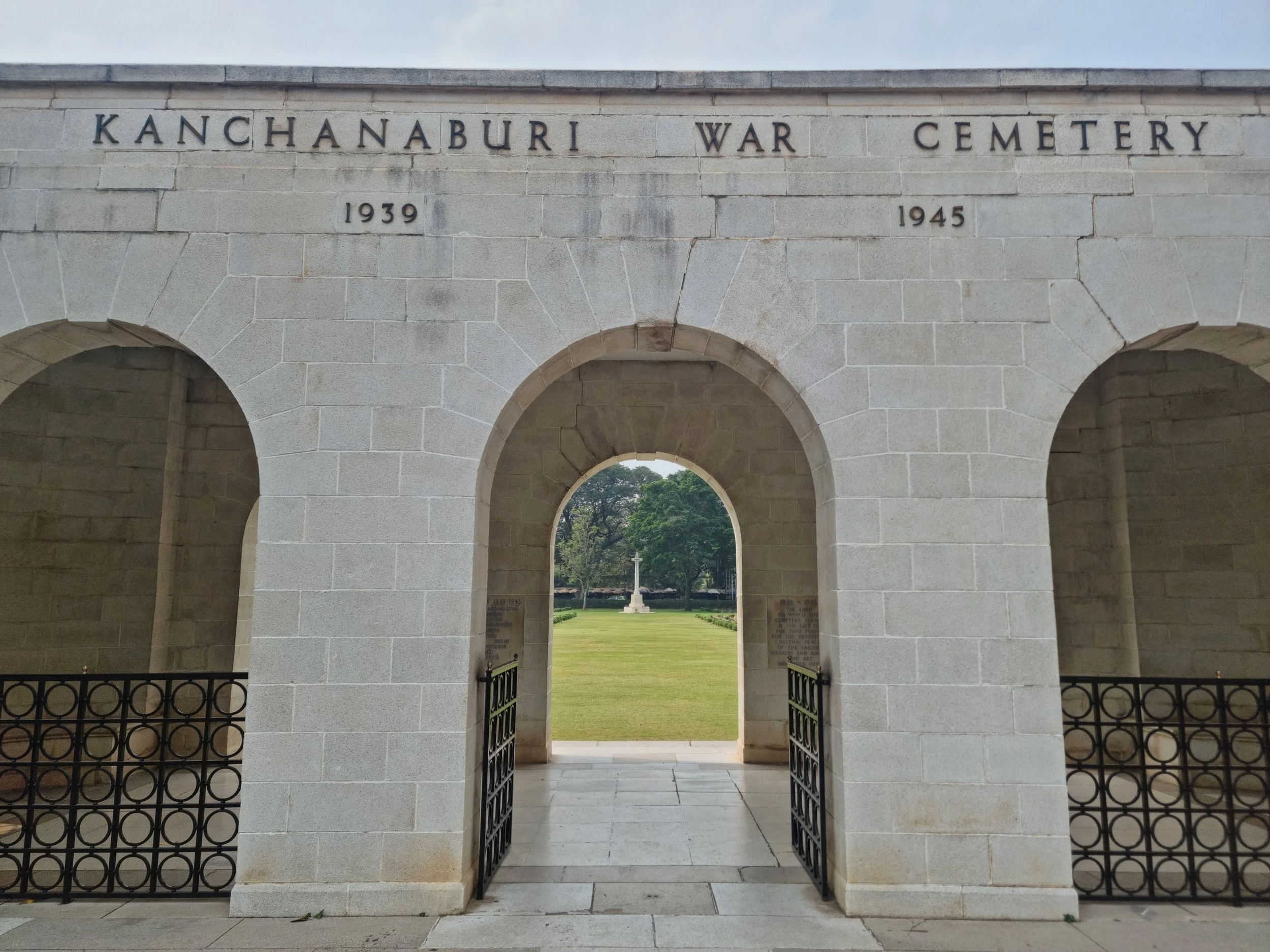
On arrival at Kanchanaburi railway station, it is just a two-minute walk to the first site of the day: the town’s war cemetery. Located in the middle of town, the cemetery, which is under the care of the Commonwealth War Graves Commission, is situated between a local school, a police station, a fresh produce market and several cafes and nail salons. I think it is for this reason that the scale of the fatalities hits even harder as you step through the entrance gates into the cemetery.
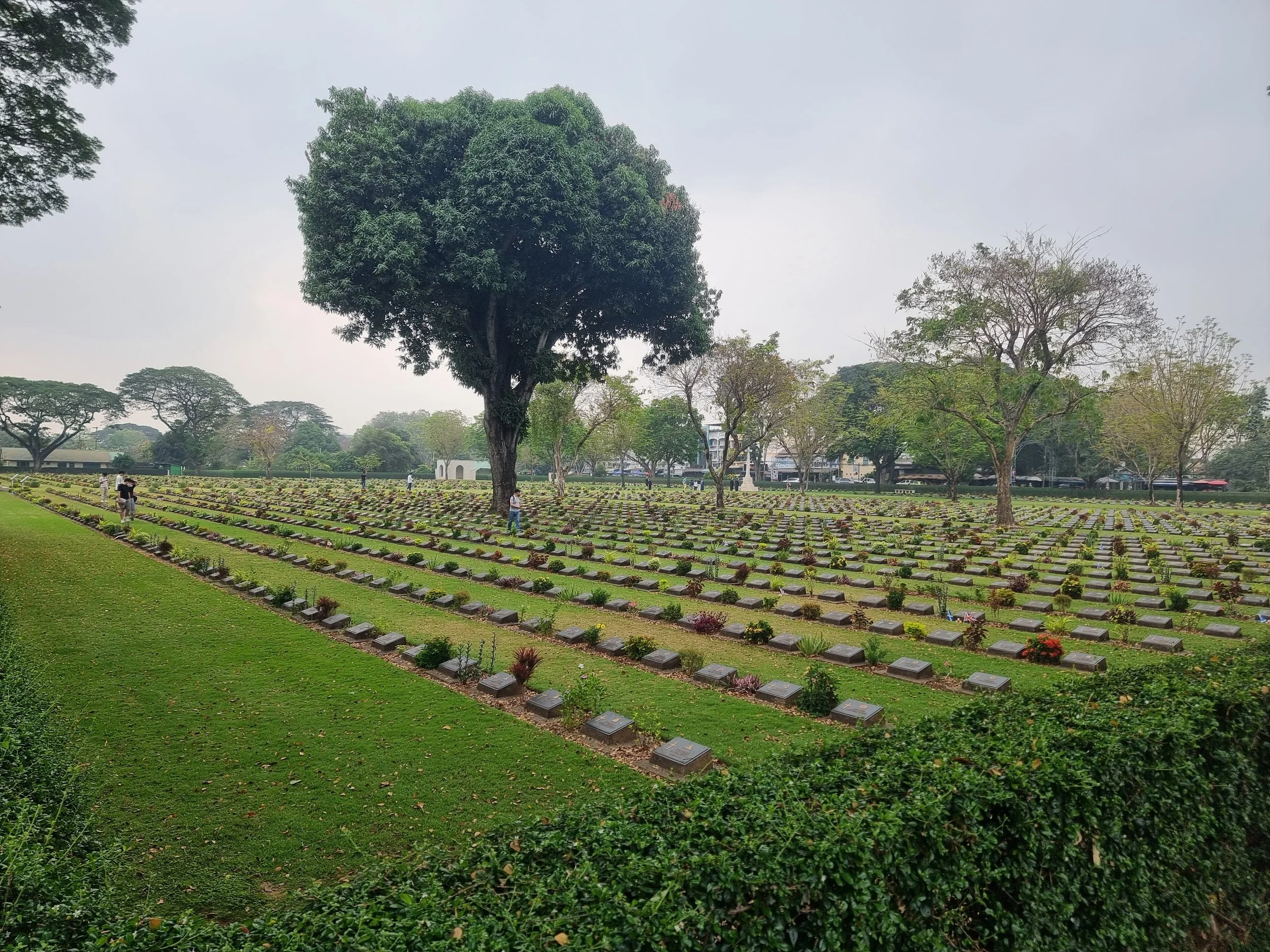
Amid the noise of beeping horns, yelling in the market and background chatter from the cafes, you are immediately met with the sight of 6,858 graves arranged in row after row. The noise of your surroundings quickly fades as you are faced with the magnitude of death that this small town played host to. Buried in the cemetery are 3,585 British, 1,896 Dutch, 1,362 Australian, 12 Indian, two New Zealand and one Canadian soldiers, many who were still in their teens or early twenties. Walking through the grounds, taking a look at the names and ages, it’s difficult to imagine what they went through and the horrors they faced at the hands of the Japanese forces.
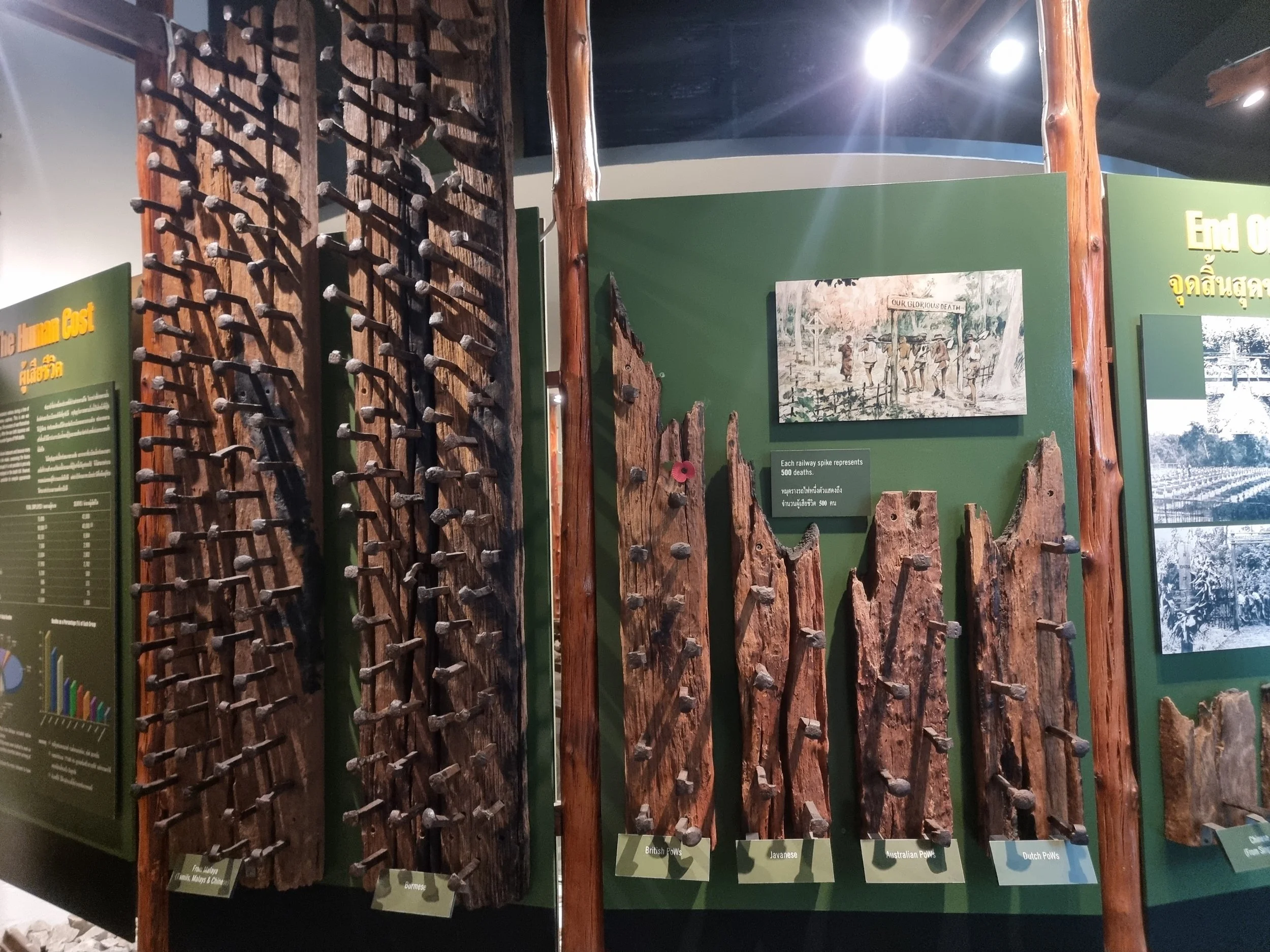
Just across the road from the cemetery is the Thai-Burma Railway Center, the main museum dedicated to the railway and the lives lost in its construction. Entry is 160 baht (5 dollars) for adults and 80 baht (3 dollars) for children aged 7 to 12, which also gets you a voucher for a free hot drink from the cafe upstairs. The center is open every day from 9 a.m. to 4 p.m., and it is a must if you want to gain a deeper understanding of the conditions in which the POWs and laborers lived. Set up by Rod Beattie, an Australian civil engineer, the center contains eight sections showcasing the history of the railway. On entry, you are greeted with the display of a large timeline: the railway’s inception in 1942, the completion of the line in 1943, the surrender of Japanese forces in August 1945, the post-war decision to sell the Thai section of the line to the Thai government and finally its closure in 1947. There are reconstructions of both the transportation used to ship the prisoners and laborers to the railway site, not much more than a wooden railway wagon, and a hospital hut, showcasing the ingenuity of the prisoners to craft medical equipment out of what little they had to take care of each other as much as they could. There are examples of the machinery and tools used to build the railway, as well as a section dedicated to the liberation of the prisoners, their repatriation, the search for bodies and the establishment of the war cemeteries along the railway line. There are also displays of recovered items from the railway, including spikes and other material used in the construction, as well as personal items recovered from the prisoner camps, like name tags, combs, cutlery and bottles. Perhaps the hardest-hitting feature in the center is the summary of deaths, a graphic display of the human cost of the railway, with each spike representing 500 dead.
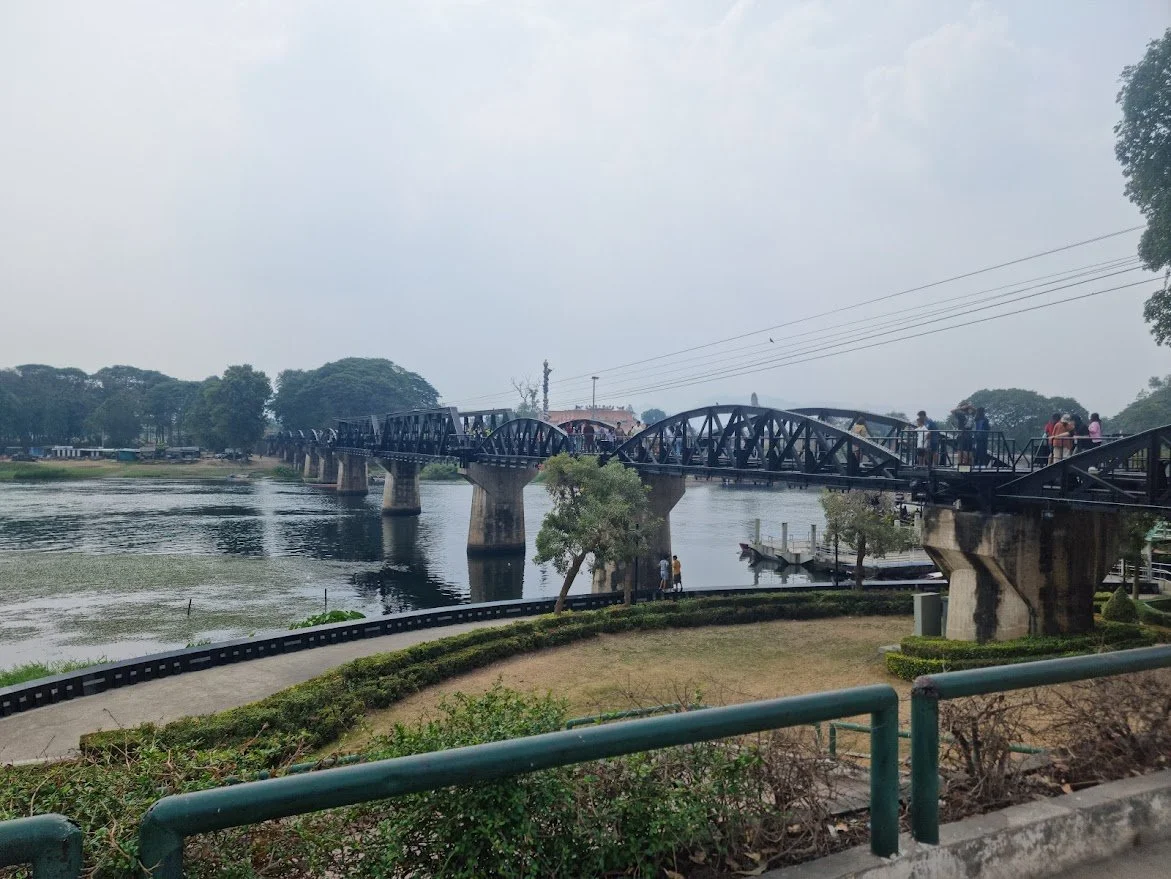
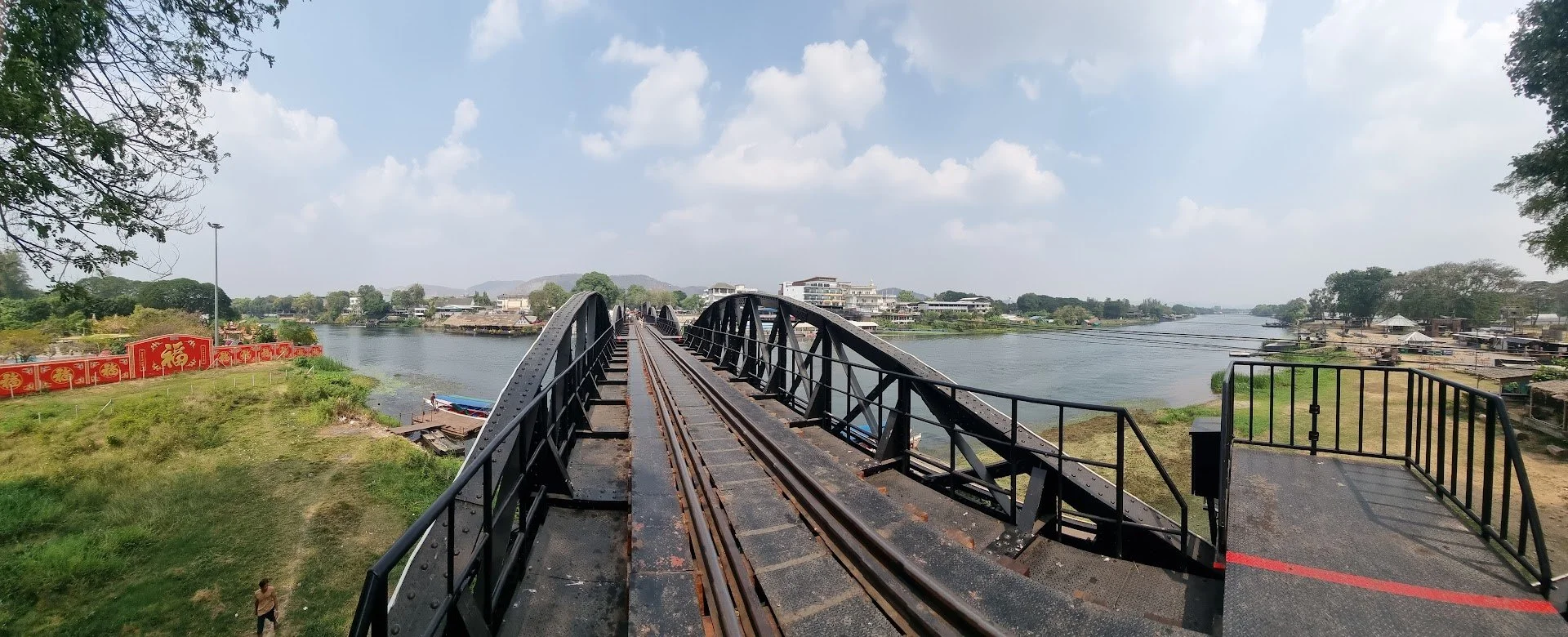
My next stop is the bridge itself. Known on the railway line as Bridge 277, it was made infamous for its depiction in the classic 1957 film starring Alec Guinness, William Holden and Jack Hawkins. The film follows a cohort of British POWs as they are transported to a Japanese prison camp, where they are forced to work on the railway and build the bridge over the river. Although the film was shot in Sri Lanka, the fictional bridge is based on Bridge 277. The site initially consisted of two bridges: a wooden railroad bridge, finished in February 1943, and the metal and concrete bridge that still stands today. The curved trusses, still in use, were brought over from Java by Japanese forces. The bridge itself is just under two miles from the railway center, so it is advisable to order a Grab or taxi, especially if you are there in the sweltering summer months.
On my visit, I choose to walk. Arriving at the site of the bridge, I am met with plenty of riverfront restaurants, markets and, of course, a few 7-Elevens. Being back in the busy Thai street life makes the presence of the bridge feel even more ominous, another sign, like the cemetery, that life has continued through the horrors of war. The bridge, as expected, is incredibly crowded, with tourists stopping for pictures along the walk. Trains do still operate here, about three to four per day, along the line up to Nam Tok, which is the last remaining station on the original line. You can go as far as through the Hellfire Pass, an area of harsh jungle land that was cleared using dynamite to make space for the railway. Sadly, I do not have enough time to incorporate this on my own journey, as there is only one train leaving Kanchanaburi to Bangkok each afternoon, although you can easily book a group tour to do the full route from the capital. There are even special train lines that run the full route on weekends and public holidays. Walking along the bridge to the other side of the river takes only about five minutes, but it is a very sobering and contemplative walk. Looking down onto the concrete structure that has stood since 1943, you are reminded of the human toil that this bridge was responsible for: the countless deaths, the brutal conditions. There are plenty of moments over the course of the day when you will ask yourself whether it was really worth it for some train tracks.
Overall, the trip to Kanchanaburi is a must if you are in Bangkok. Whether you are a history buff, interested in the Second World War or simply getting to know the local area, the trip will leave you feeling a sense of despair at the horrors that man can commit, along with a new appreciation for the sacrifices made by all those who lost their lives in conflict.
If you would like to learn more about the Thai-Burma Railway Center and its work, click here.
Note: This article was first published in Catalyst Planet


